

Forum Replies Created
-
AuthorPosts
-
I destroyed and was left stranded on the M25 by the camshaft pulley failing.
I had welded the centre.
My mistake?
Using a spring washer behind the nut. The washer failed allowing the pulley to fret. Eventually the splines wore away, red light of doom, a few hours in the services before a flatbed home.For the want of 10mm extra clearance, the rack had to come out.
The new pulley has a nyloc nut with a dab of Loctite.I did read the manual, and glazed over after a few minutes.
Your explanation is much better, thanks.
I can see my problem was not the height corrector but the linkages in the car.Enjoy the rally, is the brass band playing Benny Goodman there again?
No, I’m trying to get my ride heights correct.
Rear is fine, front pumps up to the bump stops and stays there.
Height corrector apart today and see what sort of mess I’ve made with the linkages.A genuine Citroen three sheeve water pump is worth repairing.
I think, from Aussiefrogs, the pressures needed to disassemble the pump are quite high.The rear height is easy on a Safari. Sit on the tank cover, slide into a crumpled heap, one long 11mm spanner to lock against the floor, one short 11mm, an adjustable wrench to twist the clamp and a stick cut to the correct length.
Gris Rose roof and tailgate.
Blue Camargue the rest.Two pack Nisocoat 2. Non isocyanate, in my Temu pop-up gazebo.
Today is setting front ride height. I’m welding a taller lip to the ramps as I always worry I’ll overshoot. A piece of plywood on each ramp so I can measure from the ramp to the floor, add that to the desired height and cut a stick to length.
Should be simple, will take ages…That’s the theory.
In practice, place the water pump in the wheely bin.
Dummy build prior to final tweaking. Rear left door needs attention as does front left wing.
I’ve bought one of Temu’s finest pop up gazebos to use as a spray booth.

In from the top, using the handle of the mallet to knock them in.
Don’t worry about the 120⁰ ring spacing, they rotate by themselves anyway.
When you put the sump back on, make sure the sump and block faces are properly lined up so the gearbox mates exactly.
There is enough slack to end up with a step at the sump block join.A cheapo Machine Mart engine makes life easier. You will have to modify it a bit.
Hello, I’ve been in Wales visiting my son and grandchildren. We went down the Big Pit, very interesting tour below ground of a coal mine.
I had bought a lump of plastic used to protect knock-in fence posts, the sort with a spike.
That lump fitted perfectly. I then used a club hammer to knock seven shades of it out of the liners.
I did have to bash them really hard. No heat used, the block is too big.
I just kept bashing away until they came out.
I had the block bolted to an engine stand. I propped both ends on the block with 4×2 wood so the block couldn’t move. A Workmate is no good, it is too bouncy.
The paper gasket area took a lot of work, scraping with my best wood chisel until completely clean. I used Hylomar Blue on reassembly.
Once installed, I did hold the liners down with bolts and washers.The 5th gear has an usual selection process.
3rd, 4th then somehow back to 3rd for 5th.Adie and Jamie were working on a more intuitive system, not sure what happened to that idea.
Bonnet and upper tailgate in place. Now comes the interminable fannying around to set the shuts. Great.

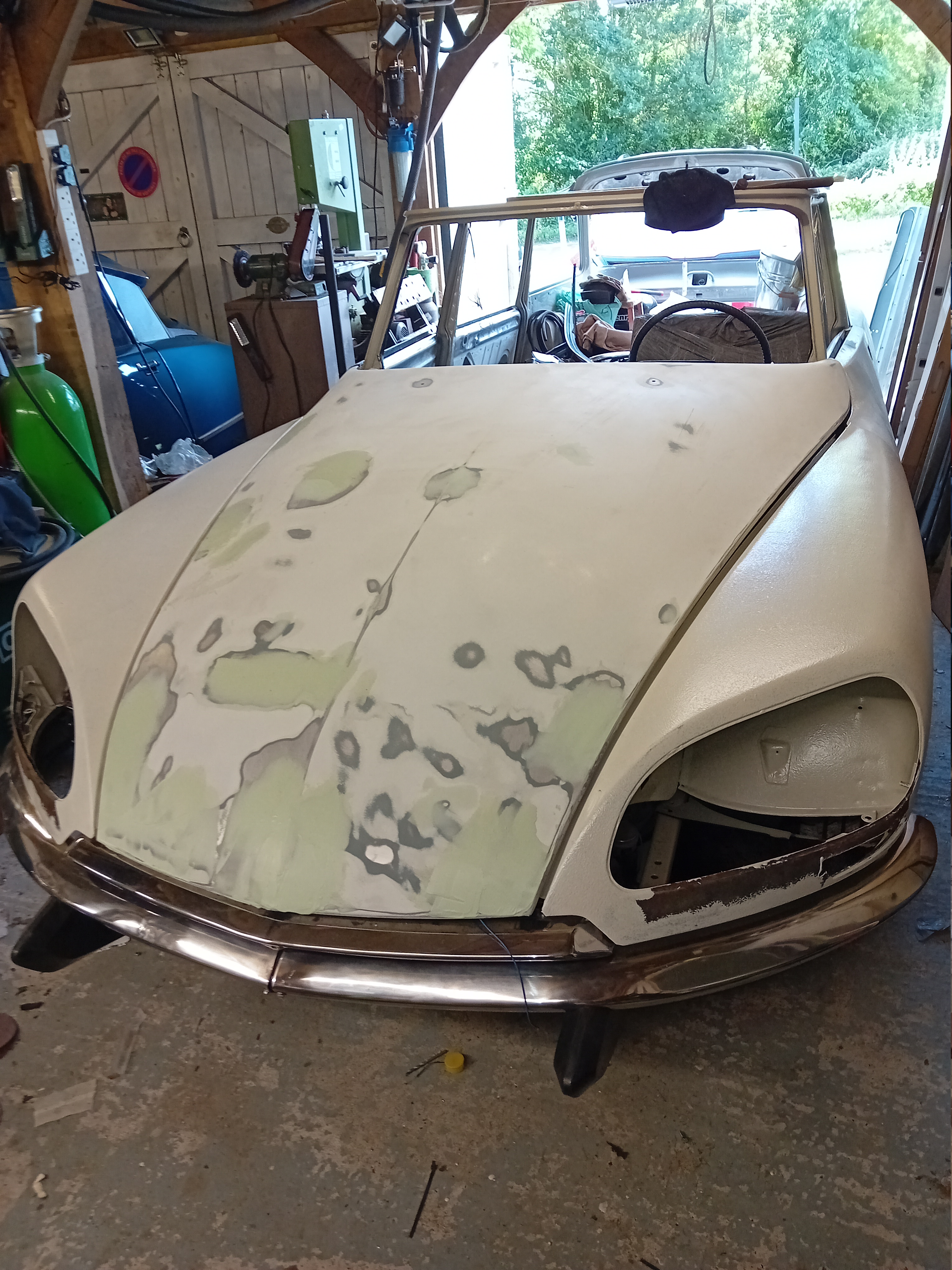
This shows the bracket attached to the water pump housing.
I used a flat bar from a starter motor bolt to adjust the belt tension.
Some gearboxes have a mounting area for a compressor. I hung mine from the water pump housing.
The condenser or condensers are the pain.
I fitted a cheap and cheerful one in front of the radiator on my DSuper5. It works ok.
On the Safari I have laid it the strapontin area with a hole in the boot floor.I would like fit either a smaller pulley on the compressor (not possible) or a larger one on the hydraulic pump, again not possible.
On a BVH I think it’s the John Titus solution. Compressor replaces alternator, the alternator sits above it.
-
AuthorPosts