

Forum Replies Created
-
AuthorPosts
-
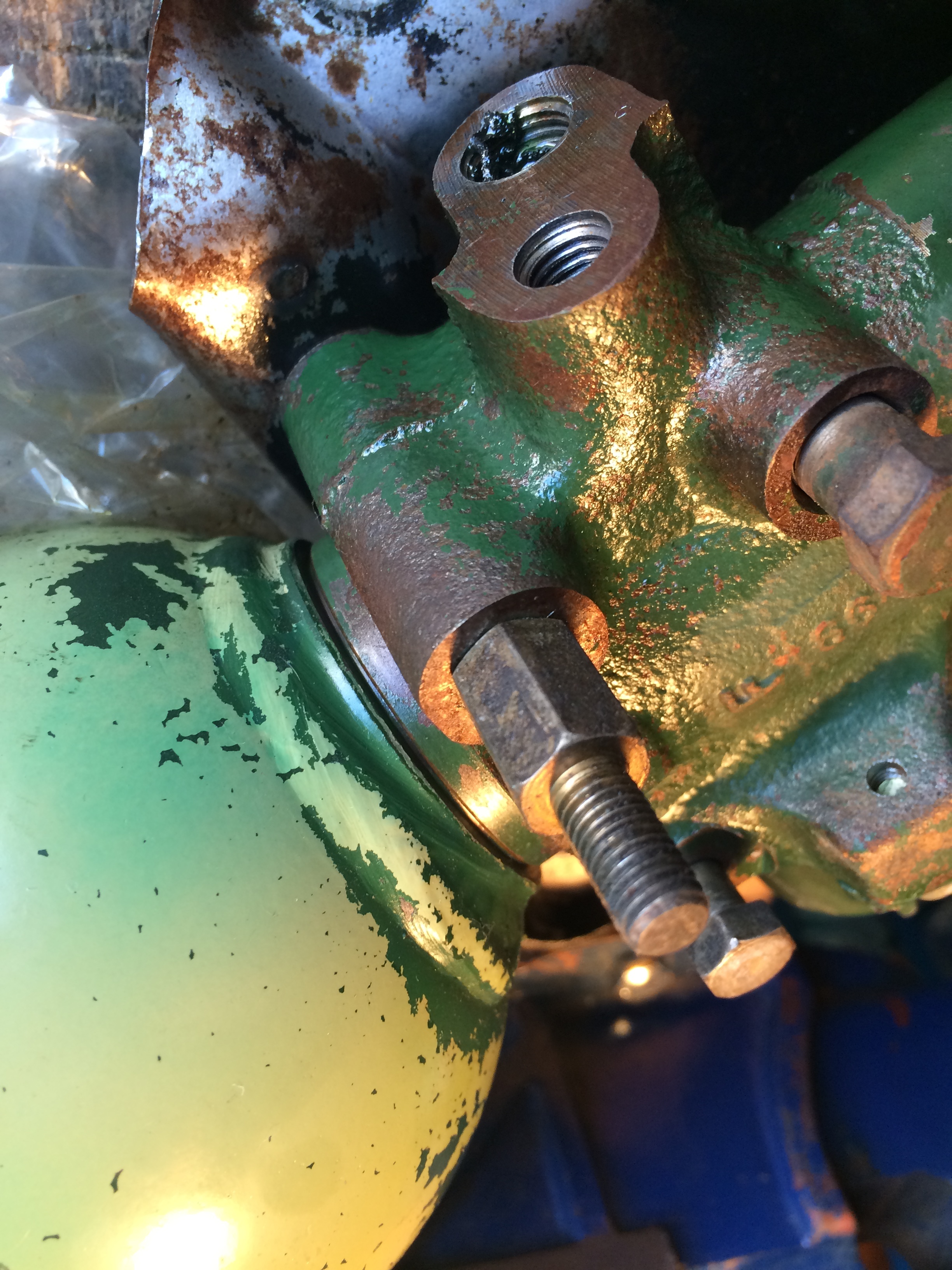
Hi. That damaged pipe is the feed of high pressure fluid from the pump to the accumulator – which it why it’s a fatter pipe. Cupronickel pipe is fine for use as 4.5mm pipe but not really strong enough for 6.35mm applications. And the pipe really needs to have Citroen flares.
Regulator position. EFI cars had them down the front of the gearbox – though not in the same position as yours – and lots of people move the accumulator/ regulator to on of the chassis legs. It’s probably been moved to give easier access for changing the sphere, but how often does one need to do that? Having said that…..if you’re uncertain of the age of your accumulator sphere and are feeling flush, then now seems like as good a time to change it as any. And yours will be a damn sight easier to get at than mine is.
Depending on the cost, you might consider getting two pipes from Darrin. Firstly just in case your bending goes wrong but if all goes well (and I really hope it does), at the very least you’ll have a spare to carry. How will you measure the length of the old pipe? Might be better to have any new one a little longer rather than find it’s too short – but you can see it’s routing so know whether that is a risk or not.
Now would also be an ideal time to re-route that pipe – something with coils to reduce stress and vibration. here’s an idea.

But if you need to rely on Darrin to make the pipe for you, you don’t have the luxury of being able to experiment and choose a different route. Maybe you could experiment with your dead pipe and then get something made up??
When you remove your dead pipe, make sure you look carefully in the threaded holes on the accumulator and pump as you will almost inevitably need to pick out bits of shredded rubber that would otherwise block your system.
Simon. After the weekend, let us know about ‘Caffeine and Machine’ and your Chichester trip.
I’m about a month away from getting mine on the road, then – like you two – it will be tentative short drives and checking under the bonnet and underneath.
That being so, i won’t be at caffeine and machine but i bet you will find some other Club members (and surely at least one other DS?) and so i think it’s an ideal stop-off point. The Midlands Section of the car Club used to organise some lovely rallies on the field in the middle of the race course. i’d love to see another rally there at some point.
One of the first things you could/ should do is download the Citroen workshop repair manuals and parts manuals.
For post 67 cars, the repair manuals are ‘manual 814’ there are two volumes.
Based on your cars door handles, it’s a 1972 model or later. In terms of parts catalogues (not that all parts are available!) it would be handy to download manuals 611 and 648. Bear in mind that your South African car may have some minor differences but the parts manuals are helpful as they show you how things fit together.
You can find all those manuals here and download them.
All credit to their owners! i just regurgitated them. Right – back to my DS doors…..
I’ve put a selection of RHD pipework photos in a folder here. i think the engine bay photos are from a thread that ran on the ‘Aussiefrogs’ forum and are possibly by ‘Bleudanube’ (aka Sven) but can’t be sure. If so, they relate to a 1966 (?) safari. Others are by Pottsy. Some others might be from Brian – the guy with a pipework query several years ago.
Hello Richard and welcome.
That is a lovely colour combination. Because of the requirement for some content of a car to be sourced from the country in which it was sold, some parts on South African cars are very slightly different to their European counterparts. only minor differences such as hub caps, door handles, door trim, seat covers and some bits under the bonnet i think/ suspect.
If the car was imported in 2019 it’s possible some of those parts might already have been swapped out to make the car more European spec. Anyway, post any questions and people here will see what they can do.
Several years ago i was trying to help a guy called Brian figure out his pipework. Not the guy you bought the pipe off is it?
You could do worse than join the Australian ‘Aussiefrogs’ forum and ask there and, along similar lines, contact the DS factory in South Africa. As major RHD markets, there may be some knowledge and expertise there.
Hi
I know the pipe you mean. On a RHD ID car, there is a 6.35mm return pipe/ hose coming from the brake valve. That is certainly true of the aluminium brake valves, and so it’s tempting to suggest that the pipe you are referring to is a continuation of that return pipe. BUT i think later valves were made of steel and a different design – so may not necessarily have a 6.35mm pipe.Also, because of the reduced room in the RH footwell, there are some odd combinations of ID and DS brake system components. After 1970, RHD ID cars had the ID braking system but a brake mushroom. So I’m guessing a RHD Ds would have a mushroom, but the DS brake system? i suppose i’m only repeating what you are already concluding.
What’s behind your question? uncertain as to what part to buy/ source? Mismatched halves? Can you trace the relevant pipe from right to left and see where it ends up – to determine its function? In addition to the one here,’ve got a few more photos that might help??

parts sellers sell a Nyloc nut for the camshaft pulley shaft, but i discovered that camshafts can have two different ends….
One end has thread all the way to the end and so seems designed for a Nyloc nut. However on other (earlier?) camshafts the threaded parts doesn’t go all the way to the end and, instead, the shaft has a little notch where you are meant to bang in (stake) the lip of a nut to secure it.
So if you blindly buy a nyloc nut for a camshaft but haven’t twigged that you have an earlier shaft, the nut screws on BUT there is no thread on the tip of the shaft for the nylon part to bite on to. and so the nut doesn’t really tighten.
I needed a stake(d) nut for my shaft and the cheapest I could find was a trailer hub nut from a caravan place.
https://ds-restoration.blogspot.com/2023/08/camshaft-pulley-nut.html
No brass band there yesterday. maybe it’s a sunday thing. I hope not.
I’m curious to see how you get on. please keep us posted. Is it a genuine Citroen pump? if so, i believe they have the part number cast into the body somewhere.
Some people add welds to the pulley rivets to give extra strength. if yours is still together and simply sans rivet heads, is there scope to weld things back together?
No, I’m trying to get my ride heights correct.
Rear is fine, front pumps up to the bump stops and stays there.
Height corrector apart today and see what sort of mess I’ve made with the linkages.In what lever position(s) does this happen?
Sounds as though the ‘cup’ that holds the ball of the height corrector is being pushed to its ‘fully open’ position (towards the nose of the car). This might be because of the linkage connected to the ARB or because of the rod arrangement connected to the height-setting lever.
It could be a sticky height corrector, or could be assembled wrongly?
I think you’ve seen it already, but i did a big write up on how i went about this.
https://ds-restoration.blogspot.com/2024/09/setting-height-corrector-linkages.html
I’ve yet to properly set my ride height. The manual says it should be done with a fully assembled and laden car – including fuel, people/ bags of potatoes, spare wheel, toolkit and a packet of sandwiches.
Have you decided on a final colour/ colours? i can’t remember.
-
AuthorPosts