

Forum Replies Created
-
AuthorPosts
-
Short term it will be fine but worth getting it looked at. Some people add ‘dyna-beads’ inside the inner tubes instead.
Have you just started to get vibrations? Have you checked the tyres for splits or bulging? Wheel nuts tight? You could try taking the wheels off and either swapping sides or rotating them to a different position – if only to see if there is a difference. I had a high speed front wheel blow out in a DS. Quite scary (though a D is probably one of the best cars to be having that kind of emergency in). Left me with a damaged wing, lost hubcap and urine stain on the drivers seat 🙂
Hi Steve.
I recently bought some Michelins for my DS at Longstones. Longstones are up between leeds and Sheffield. from where I am, that’s pretty north, if a little east. I’m sure they’d balance your wheels even if the tyre’s weren’t from them.
Alternatively, contact the CCCs Northern section. Colin Smith is Chair and a DS owner and may see this thread. if not, his phone number will be in the back of the Citroenian. Also in the back of the Citroenian is a number for David Joyce of the North West Group. If he’s not a DS driver, he can maybe put you in touch with other local DS owners.
Sure. if you are still thinking of doing it, get the job all planned out and get your supplies in and it shouldn’t take long at all.
No, I can’t see how you can use them on their own. The big, heavy body of the kit provides the stop that the die presses against as well as clamping the die body down. If you are thinking of using a vice to compress the die parts, there would not be any obvious route/ channel for the pipe to sit and nothing holding the die body down in the correct position.
You can borrow my tool and dies (4.5mm and 6.35mm). It would need to be a short term loan of a few weeks as i may find I need to use the tool once my car is back on the road. It’s heavy: 5kg. And you’d need/ want postage that has insurance for the value (as you say – about £250+). I’m going along to the Chevron’s rally at little Horwood in September. I could take it there? If you’re going, that would at least save you postage costs in one direction.
Thanks for the update.
If you had the luxury of choice, it would be good learning to put it back together with the original seal design. Could you try that and then – if it doesn’t seal – strip it again and think about an alternative seal?
I avoided it on Aussiefrogs but gave it a go here. I got about a minute in. It really is some of the sloppiest slop i think i’ve ever chanced across.
Thanks all. I’ve got a few good ball-park figures now so will ring around and see what they say.
The true test of an insurance company comes when you make a claim – something we all hope not to do – and then you find out if the money spent was worth it.
So that’s two votes for Peter James. From elsewhere, i’ve also had recommendations of Adrian Flux. Any thoughts/ experiences?
What a combination….there seem to be so may possible points of possible failure. Some of the mechanics – the seal carriers and springs – remind me of the insides of the hydraulic pump. They are also prone to shaft seal failure and a bugger to fix even if you replace the shaft seals.
I managed to access Andy’s site by taking the ‘s’ out of the ‘https’ part of the web address in my browser.
If you do the same, you can find his photos of his pressure regulator by clicking on the ‘hydraulics’ link on the LHS of the screen.
That’s weird!
I’ve had problems accessing Andy’s blog but the other dau=y managed to log on and navigate it – so i provided a link. if i follow that link today, i get the same error message i was getting before.
Anyway, he didn’t provide a lot of detail of how he went about it. He just said he used holes that are already there. he coiled the pipes to reduce stress and added a loose outer plastic sleeve to them. To stop chafing i think he said.
Well done. that sounds like a satisfying job and should now give you peace of mind.
Those holes. They look to be part of the original chase build, rather than an add-on. but I don’t think Citroen mounted the regulator to the engine bay leg on any models. If you car is a 23 efi, then it’s pretty late in DS production.
Some efi cars had the air filter pointing down on the right side of the engine, but the bracket seems to be on top of the leg – not its vertical face. (Photo copyright: Andy Todd).

BTW, Andy moved his regulator to the leg as you can see in the photo above. He writes that he was able to take advantage of existing holes, so it sounds like he used the ones in your photo. Here is a link to his blog where he mentions moving it.
http://www.citroen-restoration.co.uk/ds/item.php?category=5
My car has holes at that location – but no nuts welded inside the box section.
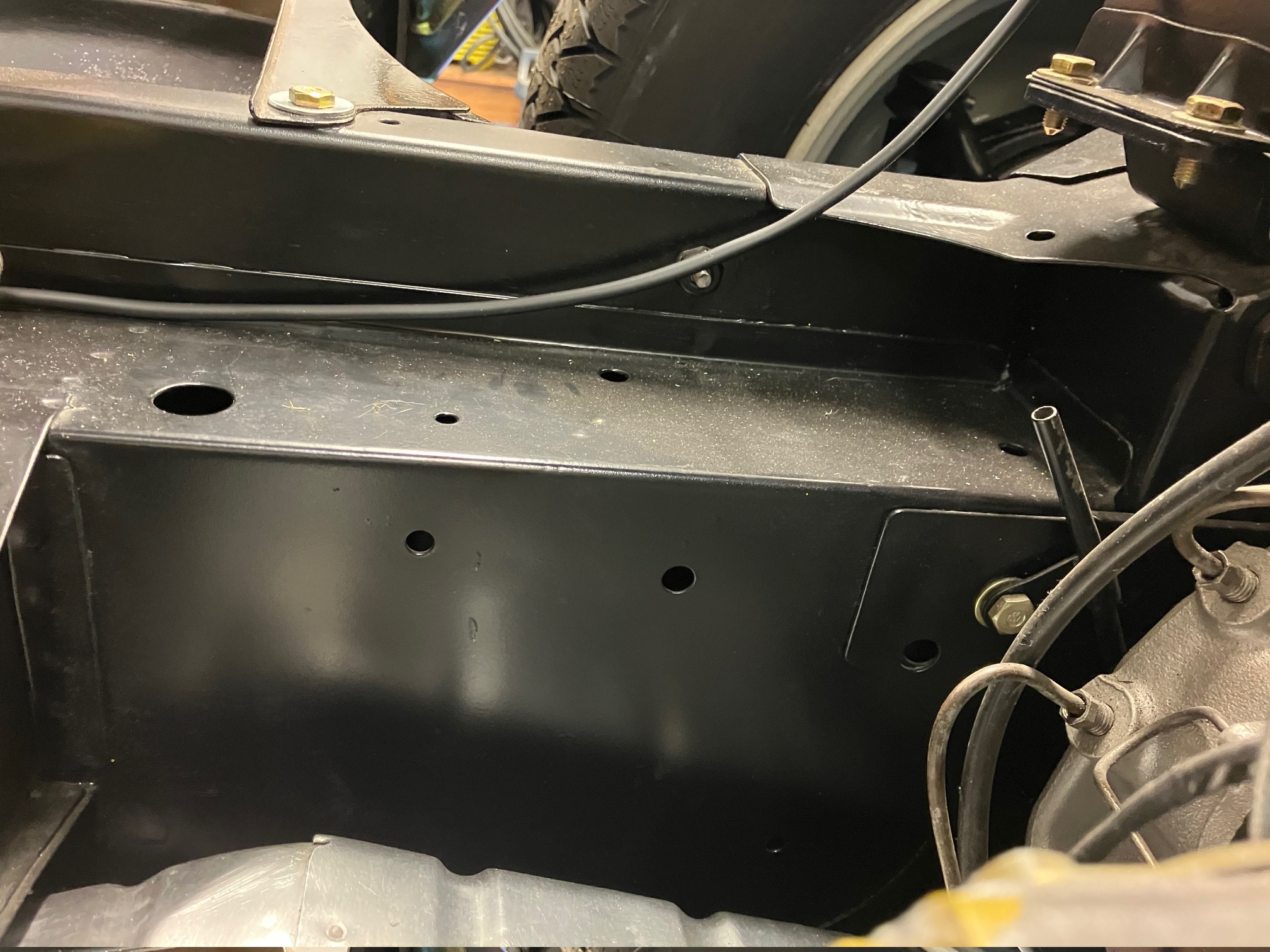
I also not that your car seems to have a strengthening plate (that mine doesn’t have) on the vertical face over those screw holes.
The cast seat has holes in it and these align with holes in the pump body. Look to be vent/drain. Any water that creeps past the seal gets drained off looks to be the idea. The pump body/cast-seat was fairly clogged up.
I guess that, as with hydraulic components, there was always an expectation/ understanding that there would be some leakage past the shaft seal. Hence the inclusion of drain holes in the design: one at the top above the shaft to let air in and prevent a vacuum, and the other at the bottom beneath it to let coolant out.
I’m trying to picture how these bits fit together. If the internal holes get blocked and the seal fails, presumably that stops the coolant venting externally, causing it to build up and soak the bearing?
….And if the external holes get blocked (but the internal are clear) coolant will back up and reach the bearing? On my original (replaced and binned) pump, the bottom external hole clogged up and water was bubbling out of the top hole. I’m almost glad that was the case otherwise i wouldn’t have been aware that the seal was failing.
I think pumps have nipples on those bottom holes. Presumably to fit a drain hose. I can see why they would do that, but use of a drain hose down into the depths of the engine bay would make it even harder to spot that the seal had failed. Not understanding the principles involved, I’m aware of more than one person being convinced they were grease nipples and pumping grease in 🙂
Simon
If you are interested, here is a link to folder with photos of regulators NOT down by the side of the fuel pump. I’m not suggesting you move yours, but the photos might give you some ideas for routing, coiling and securing your new pipes if you choose to re-route them. The link is good for 3 days only. download the photos and tuck them away.https://we.tl/t-RcuQZ99RAXrJdL3u
Someone on a US forum is considering moving his regulator and John Titus – well known and knowledgeable Citroenist – has suggested hydraulic hosing rather than metal pipes. John wrote:
“The main trick is to have a local hydraulic shop make up a ¼ inch 4,000 psi (single wire reinforced) hose with whatever ends you like (personally, I use JIC flare, but high pressure compression also works).
Then you have to make adapters from some ¼ inch steel brake line with Citroen flares at one end and fittings that go with your hose at the other end.
The 4.5mm line that goes back to the car no longer has to have vibration coils because it is no longer shaking with the engine.”
I’ve never seen the insides of a pump before – thank you.
So what would it take to rebuild it? new bearings, re-face the cast seat and replace the graphite seal? And repair the pulley?
I wonder whether the new repros pumps are made to the same design (same parts/ functions ) or whether they sweep all that away and use fewer modern parts that perform multiple functions?
-
AuthorPosts